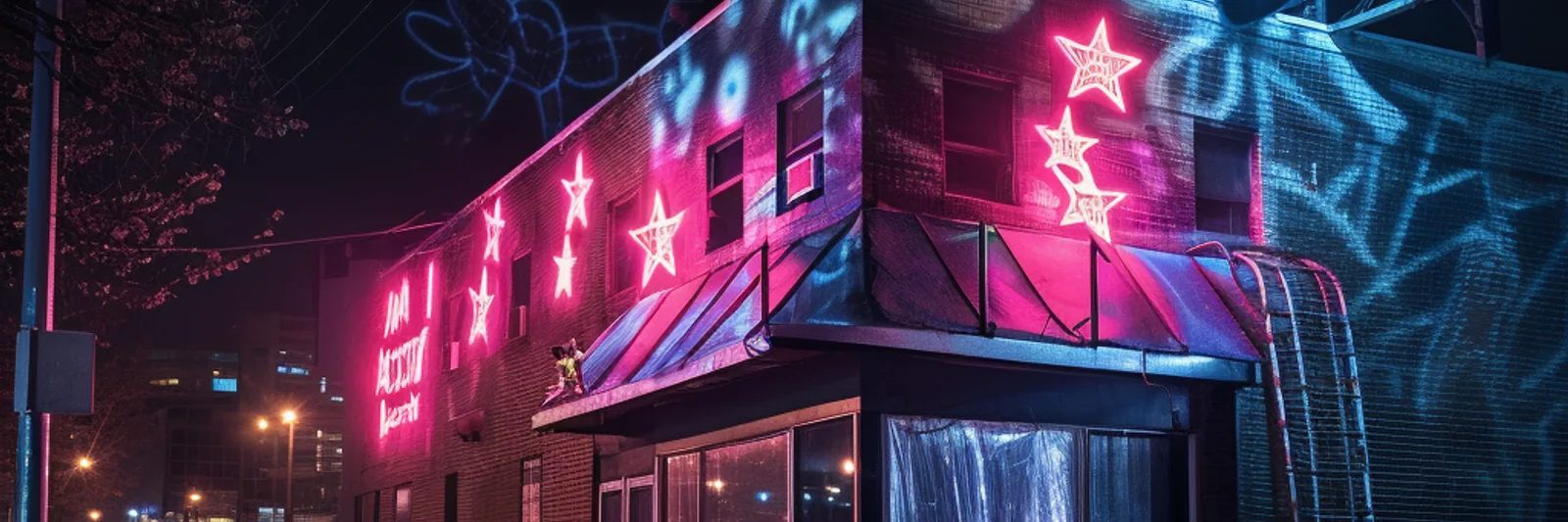
He came with one backpack.
From Times Square he walked until the city gave him the picture he had carried in his head: the bridge, the river, the cables, the proof that the country from movies and phones and other people’s lives was finally under his feet. He stopped. He took a picture. He was tired already, but not yet afraid.
I was happy. I just took a picture and finally, finally, I can see the Brooklyn Bridge by my eyes.
TAMIRLAN · 口述
Then he crossed into Brooklyn and kept going, toward a hostel in Flatbush.
The hostel cost $30. In the morning there was a Russian guy there who helped him get a ticket from New York to Washington. From Washington, Tamirlan had to get to Maryland, to the lifeguard office where his summer work would begin. He had spent money on a bed, some food, and the Greyhound ticket. By the time he left New York, there was $50 left in his pocket.
This is the contradiction he remembers with unusual clarity: America arrived first as an image, then as a series of locked doors, late buses, dead batteries, prices, misunderstandings, and strangers. It wasn't one country. It was the bridge and the rats. It was the Capitol at night and the bus station closing. It was a man with no SIM card performing confidence because there was no other costume available.
He had been abroad before. He had been to Korea. But New York, he said, was different: homeless people, rats on the street, the dirt of the subway, the scale. He was nervous. He barely slept. The Greyhound was supposed to leave at 6 p.m. He believed the time on the ticket meant the bus would leave at 6 p.m.
It didn't. They waited an hour and a half.
The driver came around 7:30. By then he was moving through the early humiliations of immigration: the rule you thought you understood was only a suggestion; the thing you prepared for wasn't the thing that happened; the country didn't pause to explain itself. He got on the bus exhausted and slept. When he woke in Washington, the first thing he saw was the Capitol.
He thought: wow, that’s cool.
Then he tried to buy the next ticket to Maryland. The seller told him it was done. The buses were no longer going there that night. The station would close. It was June, hot and late. He had food from New York in his backpack, had showered once at the hostel, and now had only a place to charge his phone and a small amount of Wi-Fi before he would be put outside.
A worker mopping the floor told everyone to leave.
I barely spoke English. I didn't understand him well, but anyway, I understood his intentions.
TAMIRLAN · 口述
Outside the Washington bus station, his phone was at 40 percent. He had no real plan. Then he remembered someone: a guy from his city, from the same agency, who had applied for the same employer. He had seen him once. He found him on a Russian social app and wrote to him.
The guy was in Alexandria, Virginia. He said Tamirlan could take an Uber and sleep there, then go to the employer in the morning.
Tamirlan had no credit card. No money for an Uber. He asked if the guy could order one and he would pay him back once he started working. The guy said he didn't have money either.
Then he suggested the only remaining option.
You can walk to me from Washington to Alexandria.
TAMIRLAN · 口述
Tamirlan Googled it.
Three hours on foot.
It was around 11 p.m.
He had one backpack.
I was like, okay, I have no chance.
TAMIRLAN · 口述
So he made the route and started walking.
The road strips you down
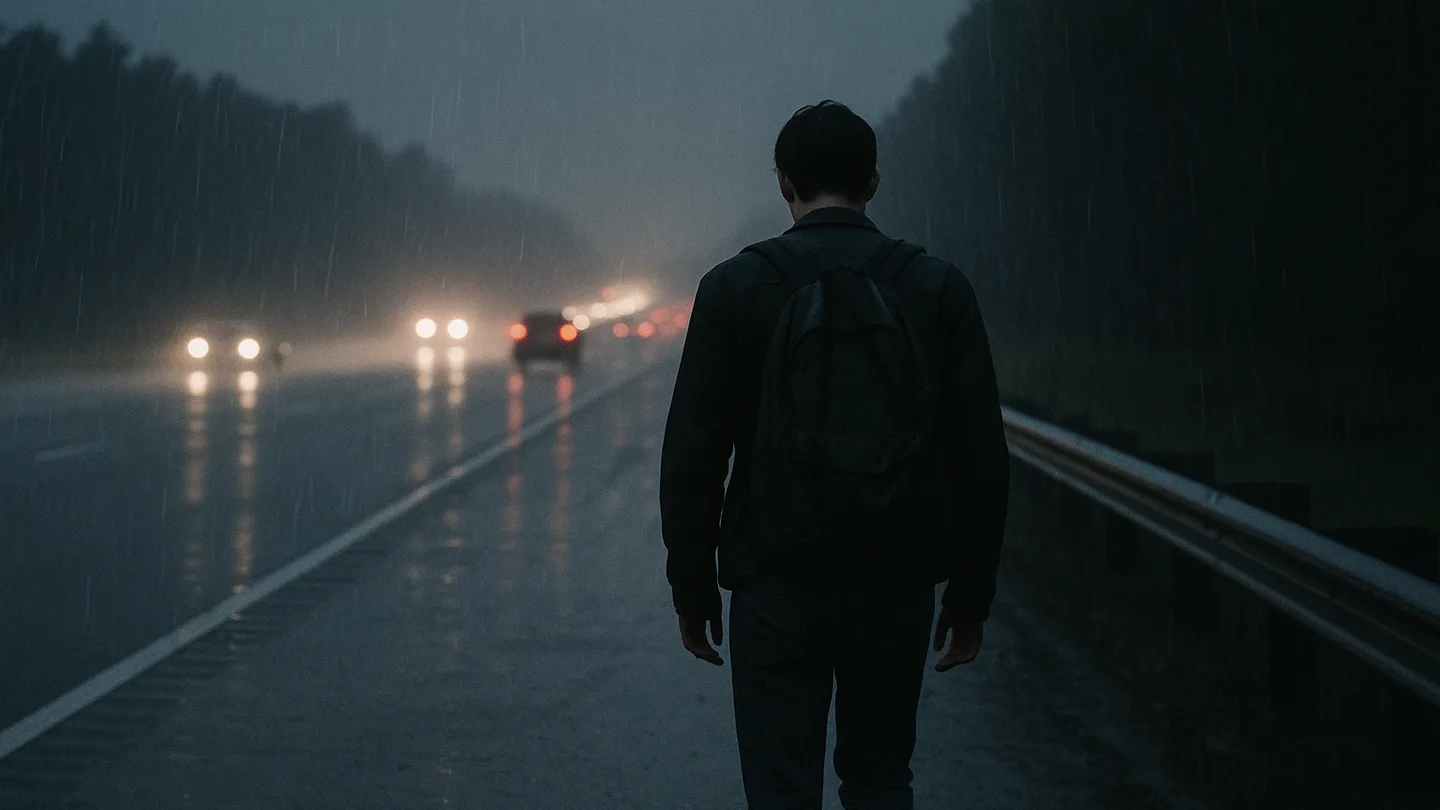
For a while, he tried to enjoy it. Washington was new to him. He watched the map, followed the route, crossed bridges, moved away from the city. He remembers an interstate — maybe 95, he said, he doesn't know. He remembers the road and the dark and the sense that he was doing the thing because there was nothing else to do.
Resourcefulness often looks heroic only after the fact. In the moment, it is mostly embarrassment with no audience.
Halfway there, the phone was at 15 percent.
Then it started raining.
Not light rain. Heavy rain. The kind that makes a backpack heavier and turns a bad plan into a question.
His phone died immediately.
I was just in the middle of the road, there was forest around me, nothing, no towns, nothing.
TAMIRLAN · 口述
This is the crest of the story because nothing is symbolic yet. There is no lesson available to him. No immigration arc, no later green card, no Miami studio, no pilot exam, no clean version. There is only a young man in the rain with $50, no English, no phone, no map, no car, no country yet.
And there is the question he asks himself.
Is that what you wanted?
TAMIRLAN · 口述
He says it again in the recording, as if the line is still standing there on the shoulder of the road.
Why you came to the States with the $50 in the pocket, your phone died, you don't know where to go?
TAMIRLAN · 口述
A man is taught, quietly and constantly, to arrive already knowing. To know where he is going, how he will pay, what to say, whom to call, how to protect himself, how not to look lost. Immigration takes that performance away piece by piece. It leaves the body. It leaves the need. It leaves the hand raised at passing cars.
Tamirlan started trying to stop them.
One car passed. Another. A third. Around ten cars went by. Then one pulled over on the shoulder, a hundred feet ahead, emergency signals blinking in the rain.
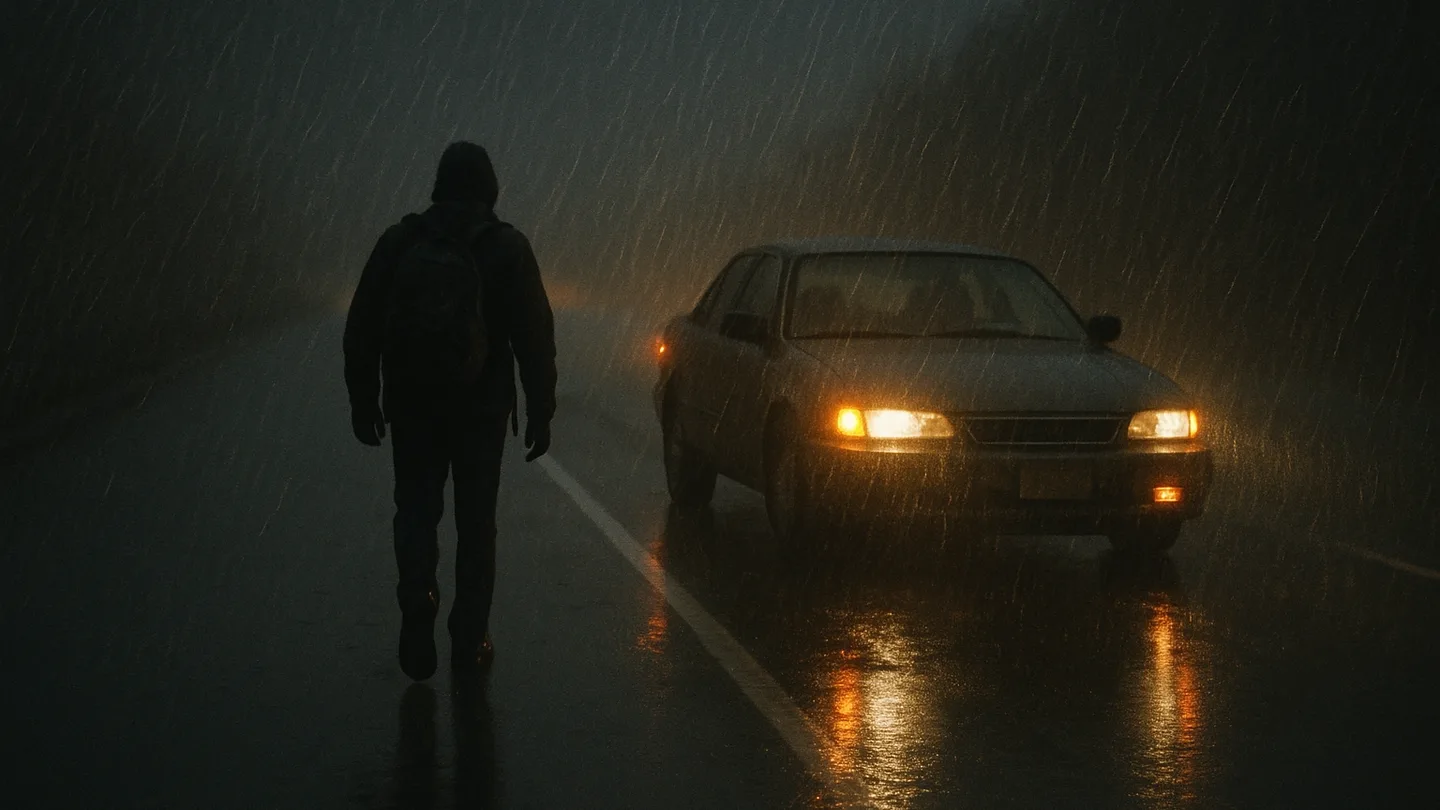
Tamirlan ran.
He got to the window. He barely had the English.
Sir, help me, help, help, I need to go to Alexandria.
TAMIRLAN · 口述
The man told him to get in.
He was Vietnamese. Tamirlan remembers this clearly. In the car, he charged his phone, gave the address, and the man drove him to Alexandria. At the apartment complex, Tamirlan had the code for the gate and the apartment number from the guy he was supposed to meet. He told the driver it was fine, that he knew the code and would be okay.
The code worked.
The apartment didn't.
He knocked. No answer. He knocked harder. No answer. He kicked the door. Nothing. He put his ear to the door. No movement inside.
Outside, he heard the Vietnamese man knocking at the front gate.
The driver hadn't left.
Tamirlan opened the gate. The man came in and asked if nobody was opening the door. Then they knocked together. Still nothing.
It's silence, complete silence in the apartment.
TAMIRLAN · 口述
They went back to the car. The man asked where he was from, what he was doing there, why he didn't speak English. Tamirlan couldn't explain it properly, so he opened Google Translate and put the story into the machine.
The man understood enough.
He lived nearby, he told Tamirlan. Tamirlan could stay with him and go to the employer in the morning.
This was another test of masculinity, but not the kind people talk about. Not toughness. Not pride. The test was whether he could accept rescue without turning it into shame.
I was exhausted, I was tired, I was wet. I didn't play that shy guy.
TAMIRLAN · 口述
He said okay.
At the man’s apartment, the stranger took his wet clothes and dried them. He fed him pizza. He told Tamirlan he had only one bed and a small apartment, that he lived alone, and that Tamirlan could sleep on the bed while he slept on the floor.
Tamirlan protested. The man refused.
No, you're my guest.
TAMIRLAN · 口述
He slept hard. He had come from Moscow, walked through New York, crossed the Brooklyn Bridge, slept poorly in Flatbush, taken a delayed bus, been put out of a station, walked into the rain, and been carried the last distance by a man who had no obligation to stop.
In the morning, the man woke him.
Tamirlan told him he could take care of himself from there. The man said no. Let me finish that.
He drove him to the employer’s exact address.
Tamirlan had the last $50 in his pocket. He was ready to give it to him.
The man wouldn't take it.
No, no, brother, don't worry about that, keep it.
TAMIRLAN · 口述
Tamirlan hugged him. Then he went inside and started working.
Fifty dollars for two weeks
He trained for three days and became a lifeguard at a pool — not on the beach, but at condominiums, apartment buildings with one big pool. The job gave him accommodation and charged it from his check. The first paycheck would come in two weeks.
Until then, the $50 had to become everything.
That was everything for me for those two weeks.
TAMIRLAN · 口述
He bought cheap ramen from places like Dollar General. He explained to his supervisor that he didn't have a car or a bicycle yet and asked if she could help him get to work until his first paycheck. She did.
At the pool there were students from Turkey, Bulgaria, Romania, China, Ukraine. He was the only Russian there. He had to communicate in another language, badly at first, then less badly. By the end of the summer, he could explain directions and understand more of what was being said to him.
After three months, I just realized that my English kind of improved.
TAMIRLAN · 口述
The summer ended in September. His visa gave him a month to travel, but he didn't intend to go back to Russia. He went straight to New York.
He lived again in a hostel, this time with men from Ukraine, Russia, Kazakhstan, Kyrgyzstan — the scattered republics of a shared language. Telegram groups became infrastructure: jobs, rooms, advice, survival. The hostel was $400 a month. Men there helped him with a driver’s license, the subway, Brooklyn, the shape of the city.
Before belonging, there is competence: the card, the train, the route, the room, the job you can stand for now.
He went to Ohio with two other men for housekeeping work at a Marriott in Cincinnati. They had an apartment, one bedroom. He lasted three weeks, made some money, and went back to New York. Then came the pedicab license and the rented rickshaw, $250 a week to rent, sometimes $1,500 a week in earnings.
On December 31, he worked all night carrying people through the city and made $2,000.
He didn't watch the ball drop.
I didn't watch that, because I was busy to carry people.
TAMIRLAN · 口述
After that, he moved through warehouse work, then construction. Near the construction job was a restaurant, and in that restaurant he met the woman who became his wife. She was Latina. Beautiful, he said. He didn't care that his English wasn't strong.
I didn't care, even if I don't speak, confidence, brother, confidence.
TAMIRLAN · 口述
Their relationship was new to him in another way. She didn't care where he worked or what his status was. He told her plainly that he was illegal in the United States, that he worked construction. She said she didn't care. The relationship later ended; the cultures were different, he said, and he knew it wasn't going to work. But from that period came a green card, and with it a different kind of ground under his feet.
Then trucking. The money became better — sometimes $13,000 or $14,000 a month when the rate rose to a dollar a mile — but the life narrowed. Truck stops meant hot dogs, pizza, fried chicken. He got fat, he said. When he later moved to Miami, he went straight back to boxing, something he had loved since high school in Russia.
Now he lives alone in a backyard studio he found through Russian Telegram groups. The rent is $1,000 a month. He does Uber to cover rent and food. He goes to the boxing gym. Sometimes to the beach. He has a girlfriend in New York, studying nursing. He is preparing for a written exam. Florida, he found, has many pilot schools, and he came because the training could be more affordable.
The plan is cargo flights.
That's what I'm going to do.
TAMIRLAN · 口述
He tells the story as if it is still slightly unbelievable to him. The bridge, the hostel in Flatbush, the Greyhound delay, the closed station, the walk, the rain, the dead phone, the man who stopped, the dry clothes, the pizza, the bed, the $50 he tried to give away and was told to keep.
Not every life changes because someone teaches you a lesson. Sometimes it changes because someone lets you into a car.
Your first impossible week
If you have your own first week — the room, the station, the mistake, the stranger, the thing you did because there was no better option — we want to hear it.